
Entrepreneurs of Bengal and the Rise of the Startup Ecosystem
For decades, Bengal has been known as the land of intellectuals, scientists, artists, reformers, and visionaries.
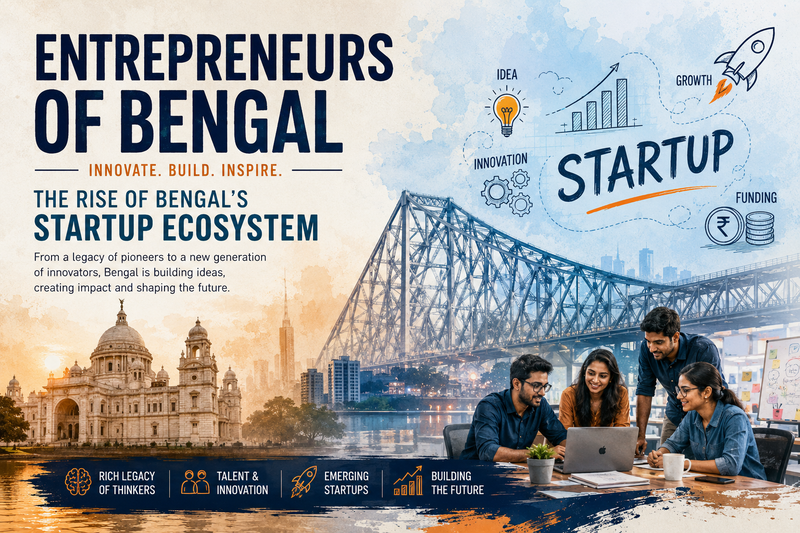

From the Bengal Renaissance to India’s freedom movement, the region has played a defining role in shaping the country’s social, cultural, and intellectual identity. Yet when conversations shifted toward entrepreneurship, venture capital, startups, and innovation-driven businesses, Bengal often found itself overshadowed by cities such as Bengaluru, Mumbai, Hyderabad, and Delhi NCR.
This perception, however, tells only part of the story. A quiet transformation has been underway across Bengal. A new generation of entrepreneurs is emerging. Universities are producing startup founders instead of only job seekers. Technology companies are being built from Kolkata. Venture capital interest is slowly increasing. Startup communities are becoming more active. Young founders are increasingly choosing entrepreneurship as a viable career path rather than a risky alternative.
The Bengal startup ecosystem may still be developing compared to India’s leading startup hubs, but it is evolving rapidly and possesses unique strengths that could define its future growth.
Bengal’s Historical Relationship with Entrepreneurship
Contrary to popular belief, entrepreneurship is deeply embedded in Bengal’s history. During the nineteenth and early twentieth centuries, Kolkata was one of the most important commercial centers in Asia. It served as the capital of British India and was home to thriving industries including jute, tea, shipping, engineering, chemicals, finance, and international trade. Bengal produced influential business leaders and industrial pioneers who helped build modern Indian industry.
Visionaries such as Acharya Prafulla Chandra Ray demonstrated that scientific innovation and entrepreneurship could coexist. Through the establishment of Bengal Chemicals, he laid the foundation for indigenous industrial development at a time when India remained heavily dependent on foreign enterprises.
However, a combination of political changes, labour unrest, industrial decline, capital migration, and economic uncertainty gradually weakened Bengal’s entrepreneurial momentum. Over several decades, secure employment became a more attractive aspiration than business ownership. Government jobs, corporate careers, and professional services increasingly replaced entrepreneurship as preferred career choices.
This cultural shift created a gap that would take generations to bridge.
The Emergence of a New Entrepreneurial Mindset
Over the last fifteen years, a significant mindset change has become visible among Bengal’s youth. The startup revolution that swept across India inspired a new generation to think differently about careers and wealth creation. Access to the internet, global business knowledge, startup success stories, digital tools, and online learning platforms exposed aspiring entrepreneurs to opportunities that previous generations could not easily access.
Today’s young entrepreneur from Kolkata is fundamentally different from the entrepreneur of twenty years ago. They are comfortable with technology, global markets, remote teams, digital marketing, artificial intelligence, and venture capital. Their ambitions extend far beyond local markets.
Instead of opening traditional trading businesses, many are building software companies, direct-to-consumer brands, fintech solutions, healthtech platforms, AI products, logistics businesses, educational platforms, and sustainability-focused ventures.
The aspiration is no longer limited to creating a small business. Increasingly, founders are attempting to build scalable companies capable of serving national and global markets.
The Foundations of Bengal’s Startup Ecosystem
Every successful startup ecosystem requires a combination of talent, infrastructure, capital, mentorship, markets, and culture. Bengal possesses several of these ingredients in abundance. The state’s educational institutions remain among the finest in the country. Institutions such as IIT Kharagpur, IIM Calcutta, Jadavpur University, the Indian Statistical Institute, Presidency University, and numerous engineering colleges produce thousands of highly skilled graduates every year.
Historically, much of this talent migrated to other cities in search of opportunities. While migration continues, a growing number of professionals are choosing to stay, return, or build companies from Bengal itself.
The rise of remote work has further reduced geographical disadvantages. A startup based in Kolkata today can serve clients in New York, London, Singapore, or Dubai with the same efficiency as one located in Bengaluru.
At the same time, Bengal offers a significant cost advantage. Office rentals, operational expenses, and employee costs remain considerably lower than many competing startup hubs. This allows founders to extend their runway and achieve more with limited capital.
These factors create a strong foundation for entrepreneurial growth.
The Rise of Modern Bengal Startups
The modern startup ecosystem in Bengal has expanded significantly over the past decade.
Technology startups are increasingly emerging across sectors such as fintech, software services, artificial intelligence, logistics, healthcare, education, mobility, and e-commerce. Consumer brands from Bengal are gaining national recognition. Food and beverage startups have demonstrated that scalable businesses can emerge from the region and compete across India.
One of the most celebrated examples is Wow! Momo, which transformed from a small startup into one of India’s most recognized quick-service restaurant brands. Its journey demonstrated that founders from Bengal could build large, nationally recognized businesses while remaining rooted in the region.
Alongside such success stories, hundreds of smaller startups are solving local and regional challenges. Many are focused on sectors particularly relevant to Eastern India, including agriculture, logistics, financial inclusion, manufacturing technology, healthcare accessibility, and educational services.
While many of these ventures remain in their early stages, they collectively contribute to a growing entrepreneurial ecosystem that did not exist at this scale two decades ago.
The Role of Incubators and Academic Institutions
One of the most encouraging developments in Bengal’s startup ecosystem has been the growing involvement of universities and educational institutions.
Entrepreneurship cells, incubation centers, startup competitions, innovation labs, and accelerator programs have become increasingly common across colleges and universities. Students are now exposed to startup concepts at much earlier stages of their academic journey.
Institutions such as IIT Kharagpur have played a particularly important role in fostering innovation and entrepreneurship. Numerous startups have emerged from these ecosystems, benefiting from mentorship, research facilities, technical expertise, and industry connections.
The increasing interaction between academia and entrepreneurship is helping bridge the traditional gap between research and commercialization.
This shift is crucial because knowledge and innovation have always been among Bengal’s greatest strengths.
Challenges That Continue to Hold the Ecosystem Back
Despite encouraging progress, Bengal’s startup ecosystem continues to face several structural challenges. The most significant challenge remains access to capital.
While startup formation has increased substantially, investor activity remains relatively limited compared to leading startup hubs. Many founders eventually relocate to Bengaluru, Mumbai, or Delhi in search of funding and stronger investor networks.
The shortage of active angel investors further compounds the problem. Early-stage entrepreneurs often struggle to secure the initial capital required to validate ideas, build products, and achieve market traction.
Another challenge is the limited number of large-scale startup success stories. Successful founders create more founders. Successful exits create angel investors. Successful companies inspire confidence among investors and attract media attention.
Bengal is still building this cycle. There is also a perception challenge. Many investors continue to view Kolkata as a secondary startup market despite the growing quality of founders emerging from the region. This perception often affects fundraising opportunities and visibility.
Perhaps the most overlooked challenge is the shortage of experienced mentors who have actually built and scaled businesses. Guidance from practitioners is often more valuable than theoretical advice. Ecosystems thrive when founders can learn directly from entrepreneurs who have navigated similar challenges.
The Unique Opportunity Before Bengal
What makes Bengal particularly interesting is that it does not need to replicate Bengaluru to succeed. Its strengths lie elsewhere.
Bengal possesses strong capabilities in research, engineering, mathematics, statistics, manufacturing, healthcare, education, logistics, and creative industries. These strengths create opportunities to build startups that are fundamentally different from the consumer internet companies that dominated India’s first startup wave.
The state is also strategically positioned as the gateway to Eastern and Northeastern India, Bangladesh, Nepal, Bhutan, and parts of Southeast Asia. This geographical advantage remains largely underutilized.
As artificial intelligence, automation, deep technology, climate innovation, and industrial transformation become increasingly important, Bengal’s intellectual and academic strengths could become powerful competitive advantages.
The future opportunities may lie less in copying existing startup models and more in building solutions uniquely suited to the region’s strengths and challenges.
Why the Next Decade Could Be Different
Several trends suggest that the coming decade may be particularly important for Bengal’s startup ecosystem. The first is the democratization of technology. Entrepreneurs no longer need massive capital to build software products, reach customers, or operate globally.
The second is the rise of artificial intelligence. AI tools are dramatically reducing the cost of building products, conducting research, creating content, and managing operations. This creates opportunities for founders operating from regions with lower operating costs.
The third is the growing maturity of the ecosystem itself. More founders are gaining experience. More startup communities are emerging. More institutions are supporting entrepreneurship. More investors are beginning to pay attention.
Perhaps most importantly, entrepreneurship is gradually becoming socially acceptable and professionally respected. This cultural shift may ultimately prove more important than any policy intervention or funding initiative.
Conclusion
The story of Bengal’s startup ecosystem is still being written. It is neither a story of decline nor a story of overnight success. It is a story of gradual reinvention. A region once known primarily for intellectual and cultural contributions is rediscovering its entrepreneurial spirit. The foundations are being laid by founders, educators, investors, mentors, and ecosystem builders who believe that Bengal can once again become a significant center of innovation and enterprise.
The ecosystem still faces challenges. Access to capital remains limited. Success stories need to multiply. Mentorship networks require strengthening. Research commercialization must accelerate. Perceptions need to change. Yet the ingredients for long-term success are already present. Bengal has talent. Bengal has ideas. Bengal has institutions. Bengal has ambition. The question is no longer whether Bengal can build a thriving startup ecosystem.
The real question is how quickly it can unlock its full entrepreneurial potential and reclaim its place as one of India’s leading centers of business creation, innovation, and economic growth.

Comments
No comments yet. Be the first to comment!